Every company has that employee.
They know which customer needs an extra call.
They understand the workaround when the system acts up.
In addition, they know which step cannot be skipped, even though it isn’t written anywhere.
They also know what to check before a job leaves the building.
They’re also a business risk if everything they know exists only inside their head.
This is called tribal knowledge.
And the bigger your company becomes, the more expensive tribal knowledge can get.
What Is Tribal Knowledge?

Tribal knowledge is information employees learn through experience but that hasn’t been formally documented or transferred into the organization’s systems.
Sometimes it’s technical, operational, or it can also be as simple as:
“Make sure you call the carrier 30 minutes before pickup.”
Nobody wrote it down.
But your best employee learned that doing it prevents problems.
That’s valuable intellectual property.
The question is:
Does the employee own that knowledge—or does the business?
Why Tribal Knowledge Creates Risk
Tribal knowledge usually works beautifully until something changes.
The employee goes on vacation.
Gets promoted.
Moves departments.
Retires.
Quits.
Or the company grows quickly and needs five other people to perform the same work.
Suddenly leadership discovers that the “process” was really one experienced person’s memory.
That creates:
- Inconsistent quality
- Longer onboarding
- Repeated mistakes
- Founder or manager dependency
- Customer-service variation
- Difficulty delegating
- Greater risk when key employees leave
The answer isn’t eliminating employee judgment.
It’s capturing what your best people know so everyone can benefit from it.
Don’t Start by Writing What You Think Happens
One of the best ways to document a process is to watch the people actually doing it.
Your strongest employees may perform steps so automatically they don’t even realize they’re doing them.
That’s why simply asking:
“What are the steps?”
may not uncover everything.
Observe the work.
Ask questions.
Bring multiple experienced employees together.
Compare how they perform the same process.
You’ll often discover that one person’s small habit produces consistently better results.
Find the Best Version
Process documentation shouldn’t preserve inconsistency.
If four employees perform the same process four different ways, the goal isn’t to create four SOPs.
Ask:
What steps are universal?
Where do the approaches differ?
Which approach produces the best result?
Why?
Can that best practice become the new standard?
This is where documentation becomes much more powerful than administrative recordkeeping.
You’re not merely recording the way work happens.
You’re identifying the best known way to perform it—and making that knowledge transferable.
Start With a Brain Dump
Inside the Process Gear of the OBS Compass, one approach is to begin with a simple brain dump.
Take one important process and list every step.
Don’t worry about making it pretty.
Or worry about formatting.
Don’t filter.
Get the knowledge out first.
Then put the steps into sequence.
Once the sequence is visible, start adding specificity.
Who performs the step?
When?
What does good look like?
And what tool do they use?
What happens if something goes wrong?
Now you’re beginning to build a usable standard.
Choose the Right Documentation
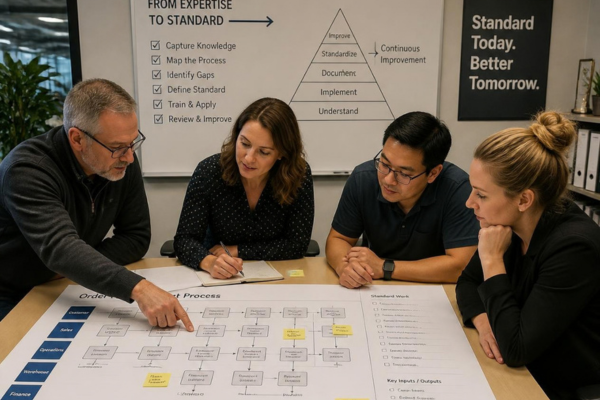
Not every piece of knowledge needs a massive SOP.
Sometimes a simple checklist is exactly what the employee needs at the point of work.
More complicated procedures may require an SOP with additional explanation and context.
Cross-functional workflows may benefit from a visual process map.
The best documentation is not the most impressive-looking document.
It’s the one people can actually use.
Test It With Someone New
Here’s one of the simplest tests of process documentation.
Give it to someone who doesn’t already know the process.
Then watch.
Where do they hesitate?
Which questions come up during the process?
What assumptions did the experienced employee make when writing it?
Is there a tool they couldn’t find?
What happens when an exception occurs?
Ultimately, every question exposes another piece of hidden knowledge.
If they need to ask, the standard still has a gap.
Don’t Punish People for Finding Gaps
No process document will be perfect on day one.
That’s okay.
The bigger danger is when employees discover gaps and quietly work around them.
Then the written process says one thing while the organization actually does another.
OBS encourages a flag, don’t work around culture.
If an employee discovers that a step is missing, outdated, confusing, or impractical, they should have a simple way to flag it.
Leadership should treat that feedback as useful information.
Update the standard.
Increase the version.
Improve the system.
Over time, the organization’s collective knowledge becomes stronger.
Your Best People Can Make Everyone Better
Great employees shouldn’t be afraid that documenting what they know makes them less valuable.
It does the opposite.
Their experience can improve the performance of the entire organization.
Instead of being the person everyone has to ask, they can help define the standard everyone follows.
That’s leadership.
And it’s how a company begins turning individual expertise into organizational capability.
Capture What Your Business Already Knows
You may already have many of the answers your company needs.
They’re simply scattered across people’s heads.
The Process Gear of the OBS Compass helps businesses identify critical processes, uncover tribal knowledge, establish practical standards, and build systems that continuously improve.
Because your best employees know things your business needs to know too.
Learn more about the OBS Compass and how Optimize Business Systems helps growing companies turn knowledge into repeatable, scalable systems.