Most growing businesses have plenty of data.
What they don’t always have is visibility.
Revenue reports. Accounting statements. CRM dashboards. Production numbers. Customer data. Spreadsheets.
Information is everywhere. Yet, when the leadership team sits down on Monday morning, not everyone answer one simple question?
Are we on track?
That is the purpose of a good business scorecard.
A scorecard does more than display numbers. It gives leadership a clear view of the company’s current performance. More importantly, it helps leaders spot changes before small problems become expensive ones.
Without that visibility, leadership often relies on assumptions, conversations, and gut feelings.
With it, teams can make decisions based on what is actually happening.
What Is a Business Scorecard?
A business scorecard is a focused collection of KPIs and performance metrics that gives leadership a regular snapshot of business performance.
The key word is focused.
A useful scorecard is not a 14-page report containing every number the business can possibly measure. Instead, it identifies the small number of metrics leadership needs to see consistently.
Those metrics should help answer questions such as:
- Are we hitting our targets?
- Are sales activities producing enough opportunities?
- Is profitability improving?
- Are customers staying with us?
- Is production keeping pace?
- Are projects being delivered on time?
- Where do we need leadership attention?
The purpose is not to collect more data.
The purpose is to make the right data useful.
Inside the Data Gear of the OBS Compass, this distinction matters. The goal is to turn important business information into something leadership can actually use to guide the organization.
KPIs Need Context
A number by itself does not tell you very much.
Imagine someone tells you:
“We generated 42 leads.”
Is that good?
Maybe.
If the target was 25, then yes. The team exceeded expectations.
However, what if the target was 100, you have a serious problem.
That is why a metric without a target is just a number.
Every meaningful KPI needs context.
Leadership should know:
- What are we measuring?
- Why does it matter?
- Who owns the metric?
- What is the target?
- How often do we review it?
- What range is considered acceptable?
- What happens when performance falls outside that range?
Without those answers, businesses often collect data without actually using it to manage performance.
A scorecard should create clarity, not more confusion.
Leading vs. Lagging Indicators
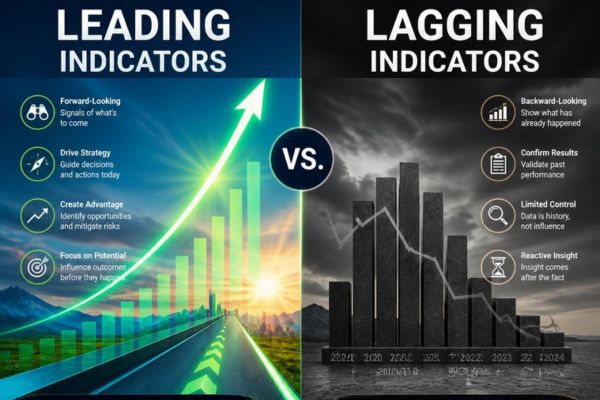
One of the most important parts of effective business performance measurement is understanding the difference between leading and lagging indicators.
Both matter.
However, they serve different purposes.
Lagging Indicators
Lagging indicators show what already happened.
Examples include:
- Monthly revenue
- Gross profit
- Net profit
- Customer churn
- Employee turnover
- Completed projects
- Customer satisfaction results
These numbers are important because they show outcomes.
However, they have one major limitation.
The outcome has already happened.
If monthly revenue falls below target, leadership cannot go back and change the sales activity that happened weeks earlier.
That is where leading indicators become valuable.
Leading Indicators
Leading indicators measure activities or conditions that can help predict future results.
For example, if your sales team has a monthly revenue target, useful leading indicators might include:
- Qualified leads generated
- Sales calls completed
- Proposals issued
- Pipeline value
- Conversion rate
- Follow-up activity
Suppose those numbers begin falling today.
You do not have to wait until the end of next month to discover that revenue may be heading in the wrong direction.
You can respond now.
Leading indicators buy leadership time.
And time creates options.
What Should a Growing Business Measure?
There is no universal business scorecard that works for every company.
For example, a construction company may need different KPIs than a transportation company.
Meanwhile, a professional-services firm may track different activities than a manufacturer.
Likewise, marketing agencies often need a different performance view from companies that manage physical production.
Ultimately, the right KPIs depend on the activities that drive performance in your business.
Depending on the organization, leadership may need visibility into areas such as:
- Sales activity
- Revenue
- Gross margin
- Cash flow
- Customer retention
- Production output
- Quality
- On-time performance
- Employee productivity
- Customer satisfaction
- Safety
- Project delivery
The goal is not to measure everything.
Instead, identify the numbers that tell leadership whether the business is healthy and where attention is required.
A smaller set of meaningful KPIs is often more useful than a massive dashboard nobody reviews.
Every KPI Needs an Owner
One of the simplest ways to weaken a scorecard is to assign a metric to “the team.”
Who updates it?
When it misses the target, who investigates the issue?
Who explains the result?
Next, who determines the appropriate action?
Most importantly, who owns the process of improving it?
If everyone owns the metric, nobody may feel truly accountable for it.
Inside OBS, critical metrics need clear ownership.
That does not mean one person personally controls every factor affecting the number.
Instead, it means one person is accountable for making sure the metric is visible, understood, and addressed.
Clear ownership creates a stronger connection between data and action.
Shared ownership is often no ownership.
Your Scorecard Is Not the Answer
This is an important distinction.
A scorecard is not supposed to diagnose every problem.
It is supposed to show leadership where to look.
For example, imagine your on-time delivery KPI falls below target for three consecutive weeks.
The scorecard may not tell you why.
Perhaps production is behind.
Maybe staffing levels changed.
Perhaps suppliers are causing delays.
Maybe the process itself contains a bottleneck.
The scorecard does not need to provide the diagnosis.
It simply tells you that something deserves attention.
From there, the situation can move into the Issues & Opportunities Gear of the OBS Compass. The team can investigate the root cause, identify what is creating the problem, and determine the appropriate action.
That creates an important distinction:
Your scorecard is not the answer. It is the question.
Create a Weekly Rhythm Around Your Scorecard

Business data becomes much more powerful when leadership reviews it consistently.
Instead of waiting for quarterly financial statements or discovering problems after a customer complains, leadership can review the same critical numbers on a regular rhythm. As a result, a weekly leadership meeting can create a simple opportunity to ask:
- Are we on target?
- What is moving in the wrong direction?
- Is a trend developing?
- Which KPI requires attention?
- Does something need to become an issue?
- Who owns the next action?
- What needs to happen before the next meeting?
Over time, this rhythm turns data into management and creates a more proactive organization. As a result, leadership spends less time reacting to surprises because the business provides earlier signals.
However, that does not mean every KPI needs an immediate response. Instead, it means leaders can distinguish between normal variation and signals that deserve attention.
From Gut Feel to Business Visibility
Entrepreneurs often develop incredible intuition.
They can walk through the business and sense when something is wrong.
For example, employees may seem overwhelmed, while customers might express frustration. In addition, sales conversations may feel slower than usual. These observations can help leaders recognize potential problems before they become larger issues.
That instinct has value.
However, intuition becomes difficult to scale.</p>
Your leaders
hip team cannot operate entirely from what exists inside the founder’s head.
As a company grows, more people need access to the same understanding of business performance.
A well-designed business scorecard begins transferring that visibility into a system everyone can use.
Instead of asking:
“How do you think we’re doing?”
Leadership can ask:
“What does the data tell us?”
That shift creates greater clarity.
It also creates something growing businesses desperately need:
predictability.
A Scorecard Should Drive Conversations, Not Just Reporting
A common mistake is treating the scorecard as a reporting document.
Someone updates the numbers.
The leadership team looks at them.
Then everyone moves on.
That misses the real value.
A strong scorecard should create better conversations.
When a KPI changes, leadership should be able to ask:
Why?
When a trend develops, the next question should be:
What does this mean?
When a target is missed, the conversation becomes:
What needs to happen next?
This turns the scorecard from a passive report into an active leadership tool.
The numbers become the starting point for better decisions.
What Happens When You Don’t Have Visibility?
Without a clear scorecard, businesses often experience the same pattern.
Problems remain hidden until they become obvious.
Sales slow down before leadership notices.
Margins shrink without immediate explanation.
Customer issues increase quietly.
Projects begin slipping.
Employees become overloaded.
Cash flow becomes tighter.
Then leadership enters reaction mode.
At that point, the business may need to solve several problems at once.
A scorecard does not prevent every problem.
However, it can help leadership see problems earlier.
Earlier visibility gives the organization more time to respond.
That can make the difference between a small correction and a major disruption.
Build Better Visibility With the OBS Compass
The Data Gear of the OBS Compass helps leadership teams turn business data into useful visibility.
That includes identifying meaningful KPIs, creating ownership around performance, understanding leading and lagging indicators, and establishing a consistent rhythm for reviewing results.
The goal is not to build a complicated dashboard.
The goal is to help leadership understand what matters.
It also connects data with the other parts of the business.
A KPI may reveal an issue.
That issue may point to a process problem.
The process problem may expose unclear ownership.
The ownership problem may reveal a gap in leadership or organizational structure.
In other words, business performance does not exist in isolation.
The numbers are connected to the system behind them.
That is why the OBS Compass looks beyond individual metrics. It helps leaders understand how vision, people, processes, data, issues, marketing, and execution work together.
Final Thoughts: You Can’t Lead What You Can’t See
Growing businesses rarely suffer from a complete lack of information.
More often, however, they struggle to identify which information actually matters.
A business scorecard helps solve part of that problem. It gives leadership a focused view of performance while creating ownership around important KPIs. In addition, it combines leading and lagging indicators. Most importantly, it establishes a regular rhythm for identifying problems before they become crises.
After all, you cannot lead what you cannot see. Likewise, you should not have to wait until something breaks to discover that it was heading in the wrong direction.
Better visibility creates better decisions. Better decisions create stronger execution. And stronger execution creates a business that can scale with greater confidence.