Ask a business owner whether their company has processes and they’ll usually say yes.
Ask whether a qualified new employee could perform one of those processes correctly on their first attempt without asking anyone what to do, and the answer often changes.
That’s the gap between having a process and having a usable process standard.
For growing businesses, that difference matters.
Because when critical knowledge lives inside employees’ heads, the business becomes dependent on individuals instead of systems.
The Hidden Problem: Tribal Knowledge
Most companies don’t intentionally build around tribal knowledge.
It happens gradually.
Susan knows exactly how this customer likes their orders handled.
Mike knows what to check before approving that invoice.
The owner knows which exceptions are acceptable.
The senior technician knows the extra step that prevents callbacks.
Everyone becomes good at their job.
Then someone goes on vacation.
Or quits.
Or the company hires three new people.
Suddenly the organization discovers how much of its operating knowledge was never actually owned by the business.
It was owned by individuals.
That’s tribal knowledge, and it creates a major barrier to scaling.
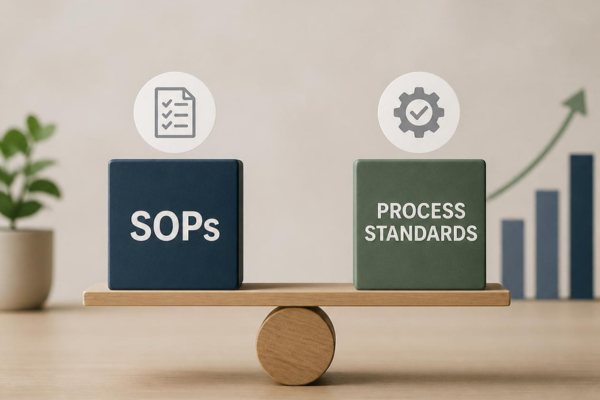
SOPs Aren’t Always the Answer
“SOP” has become the catch-all term for process documentation.
But not every process needs a 12-page Standard Operating Procedure.
Inside the Process Gear of the OBS Compass, we distinguish between different types of process documentation.
Checklist
A checklist is a sequential list of actions that confirms whether important steps were completed.
It’s useful for repetitive tasks where sequence and completion matter.
Standard Operating Procedure
An SOP provides more context.
It explains the procedure, steps, quality criteria, tools, and what should happen when exceptions occur.
SOPs are particularly useful when someone needs to understand the process deeply enough to adapt when circumstances change.
Process Map
A process map visually shows how work moves between people, departments, decisions, and handoffs.
It’s particularly useful for cross-functional workflows where several roles are involved.
The goal isn’t to create paperwork.
It’s to give people the right tool for the work they’re doing.
A Process Map Tells You What Happens. A Standard Defines What Good Looks Like.
This is one of the most important distinctions we teach.
Consider this process step:
Contact the customer.
Technically, it’s documented.
But what does it actually mean?
When?
By whom?
Using what method?
What needs to be communicated?
What happens if the customer doesn’t respond?
A stronger standard might say:
Contact the customer within two hours of job completion using the approved customer follow-up script. Confirm satisfaction and document the result in the CRM before closing the job.
Now an employee has something they can actually execute.
That’s the difference between documenting activity and documenting a standard.
Four Things a Useful Process Standard Should Answer

At OBS, effective process standards answer four major questions.
1. What Happens—and When?
Define the specific action, who performs it, and the required timeframe or trigger.
2. What Does Good Look Like?
Define the expected quality level or observable outcome.
“Complete the report” is vague.
“Submit the completed report with all required fields and manager approval by 3:00 p.m. Friday” is measurable.
3. What Tools Are Used?
Identify the templates, systems, checklists, scripts, or resources required.
If the employee has to hunt for the correct template or invent their own, consistency immediately starts breaking down.
4. What Happens When Something Goes Wrong?
Real life doesn’t follow perfect flowcharts.
Customers make unusual requests.
Equipment fails.
Information is missing.
Deadlines move.
A usable process needs an escalation path.
When should an employee make the decision themselves?
When should they escalate?
And to whom?
Without this piece, employees still end up going back to the founder or manager whenever reality doesn’t perfectly match the document.
Don’t Document Everything at Once
This is where process projects often become monsters.
A business decides it needs SOPs and suddenly somebody is trying to document every task performed by every department.
Six months later, everyone hates SOPs. 😂
Instead, prioritize.
Start with processes that are both high frequency and high impact.
These may include:
- Customer onboarding
- Order fulfillment
- Sales handoffs
- Job completion
- Quality control
- Hiring and onboarding
- Billing
- Client communication
Then look at lower-frequency processes that carry significant risk when they go wrong, such as compliance, emergency procedures, or major customer escalations.
Your first goal isn’t to document the entire company.
It’s to remove the highest-risk knowledge from people’s heads.
Your Best Employees May Already Know the Better Process

Here’s where process documentation becomes especially valuable.
You may discover that the official process isn’t actually the best process.
Your strongest employees often develop small habits that dramatically improve results—but nobody else knows about them.
When teams map a process together, those invisible practices surface.
Maybe your best salesperson asks one additional qualification question.
Your best technician performs an extra check.
Your best dispatcher makes a call 30 minutes earlier.
Your best administrator uses a simple checklist nobody else has.
Documenting processes isn’t only about capturing what leadership knows.
It’s about capturing what the organization knows.
Then making the best version repeatable.
The Document Isn’t Finished When You Hit Save
One of the biggest mistakes companies make is creating an SOP, putting it into a shared folder, announcing it in a meeting—and assuming the job is done.
Three weeks later, everyone is doing things exactly the way they did before.
Process documentation only creates value when people actually use it.
That’s why implementation matters.
At OBS, we encourage businesses to:
Introduce the standard with context.
Get input from the people who perform the work.
Launch when it’s roughly 80% ready rather than waiting forever for perfection.
Test it in the real world.
Encourage employees to flag gaps instead of creating silent workarounds.
Update the document.
Review important processes regularly.
Your standards should become living operating tools, not digital paperwork collecting dust.
A Simple Test for Your Business
Choose one critical process in your company.
Now imagine a qualified new employee starts Monday morning.
Could you hand them the documentation and have them execute that process correctly without asking you a question?
If not, pay attention to the questions they would need to ask.
Those questions show you exactly where your standard has gaps.
If they need to ask, the standard still has a gap.
Process Creates Scalability
Documented processes aren’t about turning people into robots.
They’re about giving capable people enough clarity to perform consistently.
When that happens:
Quality becomes more predictable.
Training becomes faster.
Employees become more confident.
Managers spend less time answering repetitive questions.
Customers receive a more consistent experience.
Knowledge stays inside the organization when someone leaves.
And the founder becomes less necessary to everyday execution.
That’s what makes process documentation a scaling tool, not an administrative exercise.
Build a Business That Runs on Systems, Not Memory
The Process Gear of the OBS Compass helps business owners identify their most important processes, build usable standards, capture organizational knowledge, implement those standards with their teams, and continuously improve them.
Because a process sitting inside someone’s head isn’t really a business system yet.
And if your company is going to scale beyond you, eventually the business needs to know what you know.
Learn more about the OBS Compass and how Optimize Business Systems helps companies build the structure and systems required for scalable growth.