Core values in business are guiding principles that shape how a company behaves, makes decisions, and treats the people inside and outside of it. They sit above strategy and outlast changing markets, products, and leadership. When they are clear, teams move in the same direction without constant oversight. When they are vague, every decision turns into a debate. This guide explains what core values in business are, why they matter, and how to define values your team will actually use.
What Do Core Values Mean in Business?
To define core values in business, start with what they are not. They are not slogans on a wall or words chosen for a careers page. Core values are the beliefs that govern behaviour when a decision is hard, a client is difficult, or a deadline is at risk.
In Built to Last, Jim Collins and Jerry Porras described this as a company’s core ideology: a handful of principles a business refuses to compromise for short-term gain. Their research favoured a small set, often three to five, because long lists dilute the meaning and stop guiding anything. The core values meaning in business comes down to this: they are the operating rules your company keeps even when keeping them is inconvenient.
Core Values vs. Mission and Vision
These three often get grouped together, but they answer different questions. Your mission is what you do and for whom. Your vision is where you are going over the long term. Your core values are how you behave on the way there. Values are the part that governs daily conduct, which is why they shape culture more directly than a mission statement ever will.
Why Business Core Values Matter
Clear business core values do practical work every day, guiding how a company makes decisions, treats people, and operates under pressure:
- They speed up decisions, because people who know what the company stands for resolve most judgment calls without escalating them.
- They strengthen hiring and retention by giving you a consistent standard for who fits, which reduces costly mismatches.
- They keep behaviour consistent as you add people, so growth does not dilute the standard you built.
- They create real alignment, connecting daily work to a larger purpose so the whole team pulls in one direction.
According to Harvard Business School Online, core values act as strategy as perspective: a shared lens for spotting opportunities and deciding how to act. Great Place To Work makes a similar point: clearly defined values align employee behaviour, leadership decisions, and overall strategy. For a growing company, values are one of the least expensive management tools available.
Business Core Values Examples
Strong values are specific to your company, but these business core values examples show the categories most owners draw from:
- Integrity: being honest and transparent, even when it costs something.
- Accountability: owning outcomes rather than assigning blame.
- Excellence: holding a high standard and refusing to let “good enough” become the norm.
- Customer commitment: making decisions from the client’s point of view.
- Adaptability: staying willing to change methods as the market changes.
- Respect: treating employees, clients, and partners the way you would want to be treated.
- Discipline: doing what the process requires when no one is watching.
Use these as prompts, not a menu to copy. A value only works when it reflects how your company genuinely operates and when you can point to a real decision that proves it.
How to Define Your Business Core Values
You do not need a two-day offsite to define core values in business. You need honesty about how your company already operates at its best.
- Look at your best decisions. Review the moments you are proud of and the times you refused to cut a corner, because the value behind those choices is already yours.
- Study your top people. Identify the traits of the employees you would clone if you could, since those traits point to values worth naming.
- Name three to five, not fifteen. Keep the list short enough to remember and act on, because a shorter list is a stronger filter.
- Make each one behavioural. Define what the value looks like in practice, so “integrity” becomes “we tell clients the truth even when it is uncomfortable.”
- Test them against reality. If a value would not survive a hard quarter, it is an aspiration rather than a core value, so keep only the ones you will hold under pressure.
Write them in plain language your team would actually say out loud, because values dressed up in corporate jargon rarely change behaviour.
Turning Core Values Into Daily Execution
Most companies stop at the poster. The value shows up at the all-hands meeting and disappears by Monday. The difference between values that guide a business and values that decorate a wall is whether they are built into your systems.
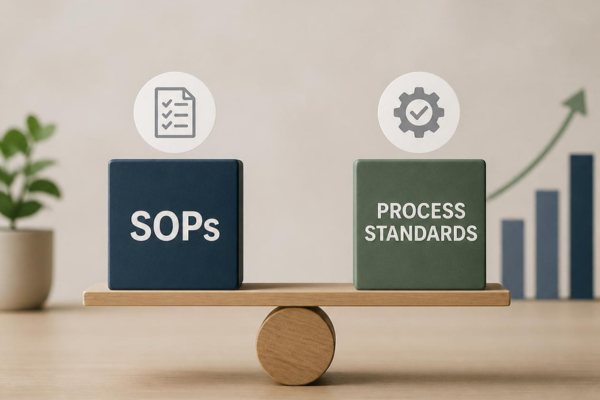
This is where values become operational. Hiring scorecards screen for them. Standard operating procedures encode the behaviour you expect. Performance reviews measure them. When values are wired into how work happens, they stop depending on any one person’s memory. That shift, from principles you hope people follow to principles your business operating system enforces, is the same move OBS helps owners make across the company: turning intention into consistent operational accountability.
Frequently Asked Questions
What is the difference between core values and company culture?
Core values are the principles a company commits to. Culture is the behaviour that actually results day to day. When the two match, your values are working. When culture drifts, values need reinforcing through hiring, systems, and leadership examples.
How many core values should a business have?
Most guidance, including the research behind Built to Last, points to three to five. A short list is easier to remember and acts as a sharper filter for decisions and hiring, while long lists tend to become wallpaper.
Can core values change over time?
The wording can be refined, but genuine core values stay stable for years, even as strategy, products, and leadership change. If a value shifts easily under pressure, it was probably a preference.
What are some good business core values examples to start with?
Integrity, accountability, excellence, customer commitment, and adaptability are common starting points. Choose the few that reflect how your company already operates at its best, then define each in behavioural terms.
Build Values That Run Without You
At Optimize Business Systems, we help owners turn values into systems that run without them, so culture supports growth instead of depending on daily oversight. Book a strategy session to build the framework that keeps your business aligned, accountable, and ready to scale.