Here’s a simple test.
Could you leave your business for two weeks with no phone, no email, and no “just call me if something happens”?
What would break?
For many successful business owners, the answer is uncomfortable.
The company may have significant revenue, dozens of employees, experienced managers, and years of operating history.
Yet, remove the founder and cracks start appearing.
Decisions slow down. Employees wait for answers. Problems move upward. Important information becomes harder to find.
The business still has people.
It may also have software, processes, managers, and years of experience.
But too much of the operating system still lives with the owner.
Building a business that runs without you does not mean abandoning your company.
It means building a company that can function properly without requiring your constant involvement.
That is the difference between owning a business and becoming the business.
Why Do Successful Businesses Become Owner-Dependent?

Founder dependency often develops for understandable reasons.
During the early stages, the founder handles almost everything.
You sell, hire, solve problems, approve expenses, manage customers, and make operational decisions.
At that stage, moving quickly can give a small company a competitive advantage.
However, the business eventually grows while its operating model remains unchanged.
As the team expands, the company serves more customers, adds managers, and faces a growing number of decisions. In addition, its processes must work consistently across the organization.
Despite these changes, important decisions still flow through the same person.
Eventually, the founder becomes the organization’s unofficial operating system.
That creates a problem.
The business can grow in size while remaining dependent on one person’s knowledge, judgment, and availability.
At that point, growth can create more complexity instead of more freedom.
What Does a Business That Runs Without You Actually Need?
A business that runs without constant owner involvement does not happen because the owner simply steps away.
The organization needs enough clarity and structure to operate well without constant intervention.
That means people need a shared direction.
Roles need clear ownership.
Leadership needs visibility.
Problems need a place to go.
Critical knowledge needs to exist outside individual people’s heads.
The organization also needs a consistent way to turn priorities into action.
These capabilities connect across the OBS Compass.
The seven Gears are:
- Vision
- People
- Marketing
- Data
- Issues & Opportunities
- Process
- Execution
Together, they help leaders look at the business as an operating system rather than as a collection of disconnected problems.
Step 1: Give Everyone the Same Destination
People cannot make aligned decisions if they do not understand where the company is going.
A business that runs without constant founder involvement needs a clear Vision.
Leadership should understand:
- Why the company exists
- What it stands for
- Who it serves
- Where it is going
- What the next several years should look like
- What matters most right now
When direction exists only inside the founder’s head, employees have to keep returning to the founder for context.
That creates dependency.
Shared Vision begins distributing that context throughout the organization.
Instead of asking the founder what matters every time a decision appears, leaders have a clearer reference point.
That does not eliminate judgment.
It gives judgment a direction.
Step 2: Clarify Who Owns What
Next comes ownership.
One of the fastest ways to create founder dependency is unclear responsibility.
Consider what happens when two leaders both assume the other person owns an outcome.
Decisions move upward.
As a result, the founder gets involved and the problem gets solved.
Unfortunately, the same pattern happens again.
That is not simply a people problem.
It is an ownership problem.
OBS uses the Responsibility Blueprint to create greater clarity around responsibilities and ownership throughout the company.
The KOD framework — Know It, Own It, Deliver It — also helps leaders look at whether someone understands the responsibility, genuinely owns it, and delivers the expected result.
The goal is not delegation for the sake of delegation.
The goal is to create an organization where the right people can make the right decisions at the right level.
That is a major step toward reducing owner dependency.
Step 3: Give Leaders Visibility Without Requiring Constant Involvement
Founders often struggle to step back because they believe stepping back means losing visibility.
It should not.
This is where Data becomes important.
A focused business scorecard gives leadership a consistent view of the KPIs that matter.
Instead of personally checking every part of the business, the owner can see whether critical outcomes are on track.
For example, leadership may monitor:
- Revenue
- Sales activity
- Customer retention
- Gross margin
- Operational performance
- Project delivery
- Other critical business KPIs
The exact metrics depend on the company.
The principle is simple.
Good systems do not make the founder less informed. They allow the founder to stay informed without being involved in everything.
That distinction matters.
If the only way an owner can know what is happening is by personally asking everyone, the business still depends on the owner for visibility.
A useful data system changes that.
Step 4: Teach the Organization to Solve Problems
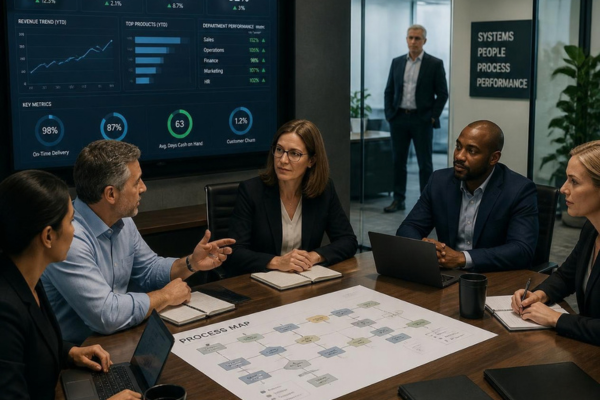
If every significant issue eventually reaches the founder’s desk, the company remains dependent on the founder’s judgment.
That creates another bottleneck.
Growing companies need a structured way to surface and solve Issues & Opportunities.
Teams should understand:
- What requires leadership attention?
- What can a department solve?
- What belongs in a one-on-one?
- What is the root cause?
- Who owns the resolution?
- What decision needs to be made?
The Issues & Opportunities Gear gives unresolved problems and opportunities a structured place within the operating system.
That matters because problems do not disappear when nobody addresses them.
Instead, employees create workarounds.
Managers spend more time firefighting.
The founder gets pulled back into decisions that should have been handled elsewhere.
A stronger problem-solving system helps move that responsibility into the organization.
Step 5: Get Critical Knowledge Out of People’s Heads
Think about the processes your company cannot afford to get wrong.
Now ask:
Are those processes documented, or does someone simply know how to do them?
That distinction matters.
When critical process knowledge lives inside one person’s head, the business becomes dependent on that person.
Consider what happens when they become sick.
What if they leave the company?
Similarly, how would the business operate if it opened another location?
Could a new employee learn the process without relying on them?
A documented process creates a reference point.
Useful process standards establish:
- What happens
- When it happens
- What good looks like
- What tools are used
- What happens when something goes wrong
The goal is not to document every activity in the company.
Instead, identify the processes where inconsistency creates risk, cost, customer problems, or unnecessary dependence on specific people.
That is how process documentation supports a more scalable business.
Step 6: Create a Consistent Operating Rhythm
A business does not become independent simply because leadership creates a plan.
The organization needs a way to keep important work moving.
Leadership may define the Vision.
Roles may become clearer.
KPIs may become visible.
Processes may become documented.
Priorities may be identified.
Yet the business can still struggle if nobody consistently follows through.
That is why operating rhythm matters.
Priorities need ownership.
Meetings need purpose.
Decisions need follow-up.
Performance needs review.
Problems need resolution.
The new OBS guide identifies Execution as Gear 7, while the detailed official Execution methodology is still being finalized.
So the practical principle is straightforward:
Knowing what should happen is not the same as making it happen consistently.
A business that runs without constant owner involvement needs a reliable way to keep priorities visible and work moving.
Founder Freedom Does Not Mean Founder Absence
There is an important misconception about building a business that runs without you.
It does not mean you should stop being involved.
It means your involvement becomes a choice instead of a requirement.
Maybe you love sales.
Stay involved.
Maybe you enjoy strategy.
Spend more time there.
Maybe you want to develop your leadership team.
Do that.
Perhaps you want to launch another company, travel more, spend time with your family, or eventually sell the business.
The point is simple.
Your company should not dictate your choices because everything collapses when you leave.
A strong business gives the owner options.
That is what founder independence is really about.
Use the Two-Week Test to Find Your Biggest Dependency
Ask yourself again:
Could I leave for two weeks without being involved?
If the answer is no, start by identifying why.
For example, people might lack direction, while important decisions could stall.
Would employees know who is responsible?
Could performance become difficult to track?
Would unresolved problems continue to affect operations?
What about quality or critical processes?
Each answer points toward a system the business needs to strengthen.
You do not have to fix everything at once.
Instead, start with the dependency that creates the greatest risk.
Then work backward to identify the cause.
Which information is missing?
Where does responsibility remain unclear?
Are important processes still stored only in someone’s head?
Which decisions keep returning to the owner?
Furthermore, what problems does leadership repeatedly have to solve?
Together, these questions can reveal where the organization still depends too heavily on the founder.
What Does a Self-Managing Business Look Like?

A self-managing business does not mean a business without leadership.
It means leadership is distributed through a clear operating structure.
People understand the direction.
Roles have ownership.
Leaders have visibility.
Problems have a place to go.
Critical processes are documented.
Important priorities remain visible.
Decisions can happen at the appropriate level.
The founder can still lead.
However, the founder does not have to personally carry every part of the business.
That is the real shift.
Build the Company Beyond the Founder
The OBS Compass brings seven interconnected areas together:
Vision. People. Marketing. Data. Issues & Opportunities. Process. Execution.
Each Gear addresses a different part of how the organization operates.
Together, they help leadership look beyond individual problems and examine the system supporting the business.
That matters because founder dependency rarely comes from one issue.
For example, the company vision may be unclear, or responsibilities may not be well defined.
Meanwhile, leadership might lack visibility, and recurring problems may have no structured resolution path.
In addition, critical processes may depend on tribal knowledge, while priorities receive inconsistent follow-through.
Ultimately, the answer is not simply for the founder to “delegate more.”
The answer is not simply for the founder to “delegate more.”
The organization needs enough structure, leadership capacity, accountability, and consistency to operate without constant owner intervention.
Final Thoughts: Build a Business You Can Step Away From
The goal of building a business that runs without you is not to make yourself irrelevant.
It is to make your business stronger.
When the organization has shared direction, clear ownership, useful data, structured problem solving, and reliable processes, the founder does not have to personally carry every decision.
That creates capacity.
It also creates options.
You can spend more time on strategy , develop your leadership team, can even focus on growth and can take a real vacation.
Or you can simply know that the company is capable of functioning when you are not in the room.
The ultimate measure of a successful business is not how much the owner can personally carry.
It is how strong the organization becomes when the owner stops carrying everything.
Bottom Line
A business that runs without you is not built by stepping away first. It is built by creating the clarity, ownership, visibility, problem-solving structure, and processes that make your constant involvement unnecessary.
If your business still depends heavily on you, that does not mean you have failed.
It means the organization has reached a point where the way it operates needs to evolve.
The next question is not:
“How do I work less?”
It is:
“What does my business need so it can operate well without me?”
That is where real founder independence begins.
Explore the OBS Compass and discover how Optimize Business Systems helps owners build stronger, more scalable businesses with less founder dependency.