Most established business owners do not have an information problem.
They have read the books.
They have listened to the podcasts, attended conferences, hired consultants, and worked with coaches.
At this point, many already know they need better accountability, clearer processes, stronger leadership, better KPIs, and more consistent execution.
Knowing is rarely the problem.
The harder problem is turning dozens of good ideas into one way of operating the business.
That is where a business operating system becomes valuable.
What Is a Business Operating System?

A business operating system is a structured framework for how an organization sets direction, assigns responsibility, measures performance, solves problems, standardizes work, and moves priorities forward.
Think about the operating system on a computer.
Individual applications perform different jobs, but the operating system helps those applications work together.
A business works in much the same way.
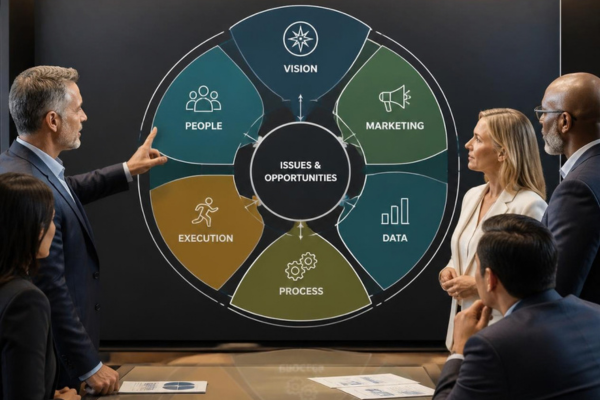
Vision cannot operate independently from People.
People cannot be fully accountable without Data.
Data can surface Issues.
Issues may expose broken Processes.
Execution is needed to turn priorities into action.
The value comes from connecting the pieces.
A business operating system gives leadership a way to see those connections instead of managing each business challenge as a separate problem.
Why Does Business Growth Expose Weak Systems?
A small company can survive on communication and hustle.
Everyone may know everyone else.
The owner usually knows what is happening.
Problems can often be solved through a quick conversation.
Then the company grows.
Ten employees become 30. One location becomes three. Revenue increases. Managers are added.
With that growth come more customers, transactions, decisions, handoffs, responsibilities, and opportunities for something to go wrong.
The informal operating model that worked beautifully at one stage can begin creating confusion at the next.
That is why growth does not automatically create a better business.
Sometimes, growth simply magnifies what was already broken.
A company can have talented people and strong demand while still struggling with unclear ownership, inconsistent processes, disconnected goals, or poor visibility.
The bigger the organization becomes, the harder those gaps are to manage informally.
Why Don’t Disconnected Business Solutions Work?
Consider a company struggling with accountability.
Leadership introduces a new performance-management tool.
The tool may be useful. However, roles are still unclear, so accountability remains difficult.
Next, the company creates KPIs.
Nobody consistently reviews them, which means the numbers provide little direction.
After that, leadership documents processes.
Employees do not consistently use them because the processes are disconnected from how the work is actually managed.
Annual goals may also be established, only to disappear into a planning document after the meeting ends.
None of these tools are necessarily bad.
The problem is that they are disconnected.
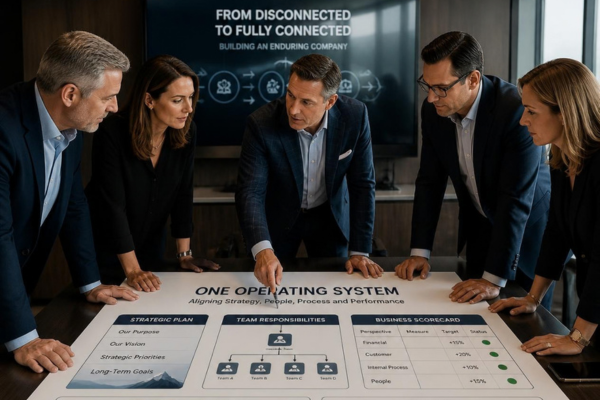
A business operating system provides a structure for connecting them.
Instead of asking, “Which tool do we need next?” leadership can ask a more useful question:
“How should the parts of our business work together?”
That shift changes the conversation from collecting solutions to building a system.
What Are the Seven Gears of the OBS Compass?
At Optimize Business Systems, the OBS Compass provides the operating framework.
It organizes the business into seven interconnected Gears:
Gear 1: Vision — Where Are We Going?
Vision creates alignment around the company’s direction.
It includes areas such as purpose, core values, niche, long-term aspiration, and business plans.
Without clear direction, different parts of the company can move toward different outcomes.
Gear 2: People — Who Owns What?
People focuses on roles, responsibilities, accountability, and leadership.
Clear ownership helps employees understand what they are responsible for and gives leaders greater visibility into who owns important outcomes.
Gear 3: Marketing — Why Should the Right Customers Choose Us?
Marketing clarifies who the business serves, what problem it solves, and what makes its approach different.
Specificity helps the company attract customers who are a better fit for what it actually provides.
Gear 4: Data — How Do We Know?
Data creates visibility through meaningful KPIs, leading indicators, and a focused business Scorecard.
Leaders need more than information.
They need useful information that helps them understand what is happening and where attention is required.
Gear 5: Issues & Opportunities — What’s Standing in Our Way?
Issues & Opportunities provides a structured place to surface problems, opportunities, decisions, and unresolved concerns.
The goal is not to hide problems.
Instead, the organization can identify what needs attention, explore root causes, and determine what should happen next.
Gear 6: Process — How Do We Create Consistency?
Process helps move critical knowledge out of people’s heads and into practical standards the organization can repeat.
That can include process standards, checklists, SOPs, process maps, and related documentation.
The result is greater consistency around important work.
Gear 7: Execution — How Do We Turn Priorities Into Action?
Execution is the part of the Compass concerned with making priorities happen.
The OBS guide identifies implementation, accountability, and operating rhythms as part of this territory. Detailed official teaching for Gear 7 is still being finalized, so the important point here is simple:
A framework only creates value when the organization actually puts it into practice.
Together, the Gears create something more useful than seven individual business tools.
They create a connected system for operating the business.
Why Is a Business Operating System More Than a Framework?
A framework alone is not enough.
You can have a well-designed operating framework and still get nowhere.
The company might complete every worksheet, build every Scorecard, document every process, and set every goal.
Six months later, the business could look exactly the same.
Why?
Because implementation is where strategy becomes reality.
This was one of the reasons OBS was created.
Its founders had experienced what it took to turn around, build, scale, and ultimately exit a business. Along the way, they saw a recurring gap in the business-improvement world.
Plenty of people could tell owners what they should do.
Far fewer stayed involved to help them actually do it.
That distinction matters.
A business can understand a concept without changing how it operates.
For that reason, OBS combines the Compass with education, implementation support, and 1:1 coaching.
The framework creates structure. Implementation turns that structure into how the company operates.
How Can a Business Operating System Reduce Founder Dependency?
The purpose is not simply to make the company look organized.
A useful operating system should change how the business functions.
People understand what they own.
Leaders have greater clarity around responsibilities and decisions.
Performance becomes more visible.
Issues have somewhere to go.
Critical work becomes repeatable.
Priorities remain visible.
Accountability becomes easier to manage.
Over time, the founder can step away from decisions that no longer need to depend on them.
That is a much bigger objective than simply creating better documentation.
The goal is to build an organization that can operate with greater clarity and consistency without requiring the owner to personally hold everything together.
You Don’t Need Another Binder
Most owners do not need another strategy document sitting on a shelf.
They need the business itself to operate differently.
That is the difference between learning about systems and installing systems into the organization.
A completed worksheet does not necessarily mean a process has changed.
A new KPI does not automatically create accountability.
A documented SOP does not guarantee consistent adoption.
A goal written during planning does not guarantee execution.
The true test is much simpler:
“Did the way our company operates actually change?”
That question forces leadership to look beyond completion and examine results.
What Should a Business Operating System Actually Change?
A strong business operating system should make the organization easier to understand and easier to manage.
Leadership should be able to see where the business is going.
Employees should understand what they own.
Teams should have meaningful measures of performance.
Problems should have a structured place for discussion and resolution.
Important work should have clear standards.
Priorities should remain visible after the planning meeting ends.
Most importantly, the different parts of the organization should reinforce one another.
That is what makes a connected system more valuable than a collection of disconnected tools.
Build a Business That Can Scale Beyond You
The OBS Compass gives business owners and leadership teams a structured operating framework across Vision, People, Marketing, Data, Issues & Opportunities, Process, and Execution.
The framework, however, is only the beginning.
Optimize Business Systems works alongside leadership teams to help turn those concepts into the structure, habits, accountability, and systems required to run a stronger company.
Established business owners rarely need more information.
What they need is clarity about what matters, a system for implementing it, and the discipline to follow through.
As the business grows, those elements become increasingly important.
A company should not need more meetings, more advice, or more disconnected tools simply because it has become more complex.
It needs a way for the parts to work together.
Bottom Line
Growing businesses do not necessarily need more advice.
They need a business operating system that connects direction, people, marketing, data, issues, process, and execution.
The OBS Compass provides that structure.
The real opportunity comes from putting the structure into practice.
When the pieces connect, leaders gain visibility, employees gain clarity, important work becomes more repeatable, and the business becomes less dependent on one person holding everything together.
That is what makes an operating system valuable.
It does not simply give you more things to manage. It gives your business a better way to operate.